As an Amazon Associate, we earn from qualifying purchases. Some links on this site are affiliate links at no extra cost to you. Our recommendations are based on thorough research and editorial judgment.


What Makes an EV Charger Outdoor-Friendly

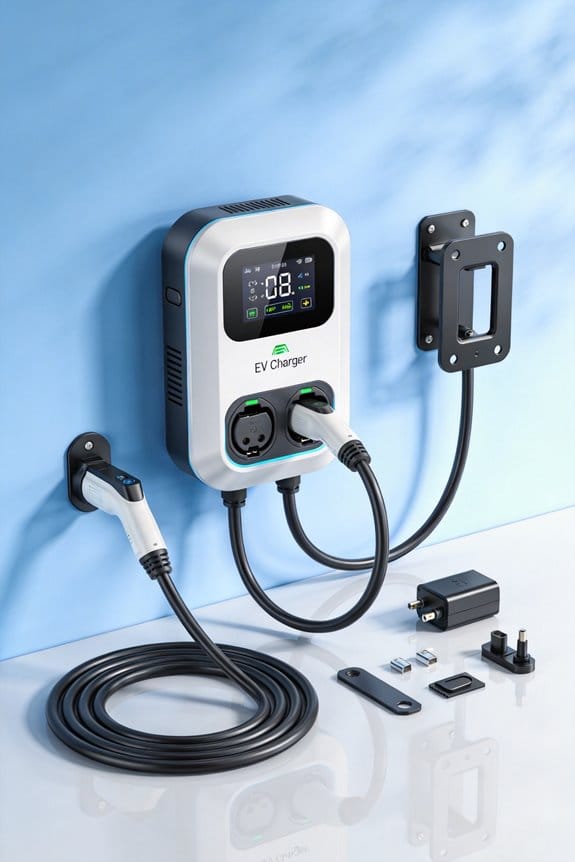
We recommend outdoor‑ready chargers that have an IP65 or NEMA 4 enclosure, a polycarbonate frame with UV stabilizers, and IK10 impact rating. Choose units rated –40 °F to 131 °F and up to 11,500 ft altitude, with surge, ground‑fault, and leakage protection. Opt for hard‑wired installation in sealed junction boxes, and verify UL 2202, CSA 22.2‑280‑16, and SAE J1772 compliance. High power factor and OTA‑enabled OCPP keep performance stable; the next sections explain each point in detail.
Key Takeaways
- Certified IP65/NEMA 4 (or higher) enclosure ensures dust‑tight, water‑jet and rain protection.
- UV‑stabilized polycarbonate housing with IK10 impact rating resists sun damage and mechanical abuse.
- Temperature‑rated operation from –40 °F to 131 °F and altitude derating up to ~11 500 ft maintain performance in extreme climates.
- Proper grounding, surge/ground‑fault protection, and sealed wiring (hard‑wired or weather‑proof plug‑in) meet NEC/CEC safety standards.
- Remote diagnostics (OCPP) and OTA firmware updates enable early fault detection and continuous compliance.
How to Choose the Right Outdoor EV Charger
You may be interested


Ever tried plugging your car into a charger that just can’t handle a drizzle? That’s the last thing you want when you’re trying to get on the road. The first thing to check is the enclosure rating – it tells you how well the unit deals with rain, dust, and bumps. I always look for at least an IP65 rating and NEMA 4 protection, because those levels keep most weather at bay. Weather‑proof connectors that seal tight against moisture are a must, and a wide temperature range—say –40 °F to 131 °F—covers almost any climate you’ll face.
Frankly, the right charger makes life a lot smoother. Here’s the trick: focus on three core things before you buy. First, the enclosure. You want IP65 or higher and NEMA 4, so the box can stand up to rain and splashes without a hiccup. Second, the connectors. Make sure they’re weather‑proof and compatible with SAE J1772, which is the standard most EVs use. Third, the power options. Having a portable power bank for backup can save you if the grid goes down or you need a quick charge on the go.
Now, let’s talk practical details. The cable length should be long enough to reach your car from wherever you park—18 to 25 ft works for most driveways. When you mount the charger, keep it at least 24 in off the ground to avoid puddles and debris. And don’t forget the mounting hardware; a sturdy bracket will keep the unit steady when wind or kids are playing nearby.
Worth knowing: a good outdoor charger doesn’t have to be a nightmare to install. Many models come with clear instructions and all the hardware you need, so you can set it up yourself in an afternoon. If you’re not comfortable with electrical work, a licensed electrician can handle the wiring in no time. Either way, you’ll end up with a reliable setup that lets you charge without a second thought.
These steps help you pick a solid outdoor charger without extra hassle. Ready to give your EV the home it deserves?
Recommended Products

Lightning-Fast Charging Power – Deliver up to 48 Amps and 11.5kW of power for rapid Level 2 charging—get EVs back on the road faster than ever.

THE BRAND YOU TRUST – Leviton has been in homes for over a century and electrifying vehicles for over a decade. Charge at ease with UL/Energy Star Certified stations supported by a 24/7 dedicated team

Fast Charging Without Upgrades: Overcome limited electricity service and charge at the maximum speed possible, without upgrading your panel—thanks to Emporia’s PowerSmart technology that works with your existing electrical panel to automatically balance load.
What IP and NEMA Ratings Mean for Outdoor EV Chargers
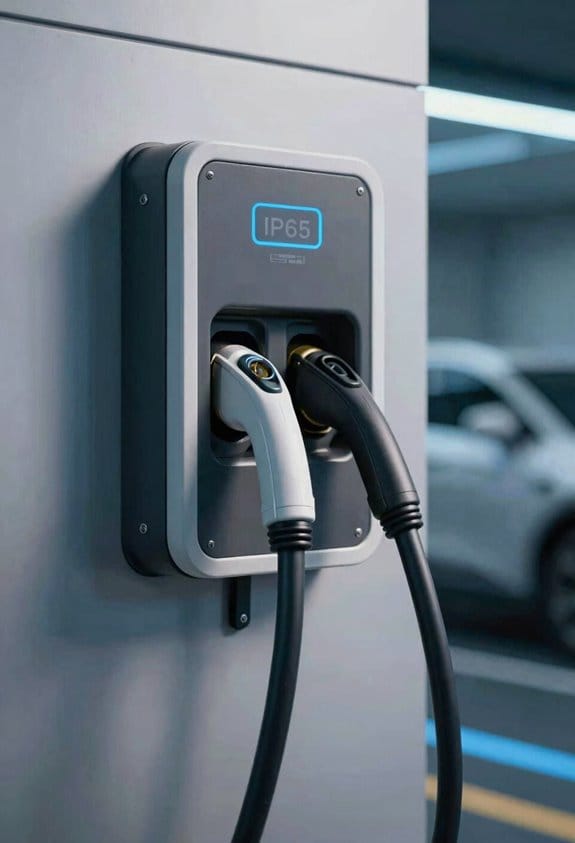
Ever tried to plug your EV charger into a storm‑y driveway and wondered why it keeps short‑circuiting? You’re not alone. The secret lies in the IP and NEMA ratings, which tell you how well the unit can keep out water and dust. Below is what you need to know, broken down into bite‑size pieces.
Recommended Products

[Energize Almost Everything] The EcoFlow DELTA Pro 3 supports 120V/240V voltage and has a 4000W output (6000W with X-Boost, scalable up to 12000W), powering nearly all essential home appliances, such as a 3-ton* central AC or a 1 HP water pump.
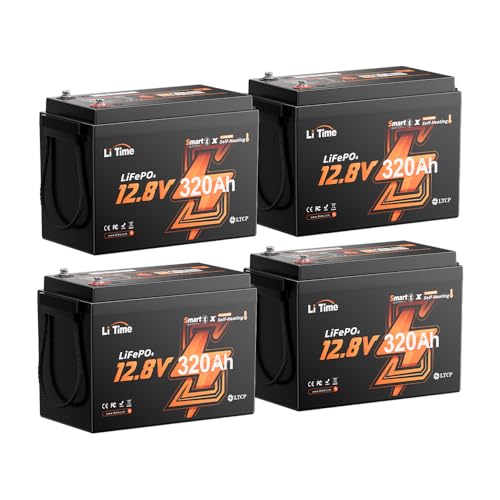
2 Upgraded Heating Modes: 12V 320Ah Mini Self-Heating Battery comes with Regular and Energy-Efficient options. Regular mode activates heating below 41℉(5℃) when charged, stops at 50℉(10℃) to begin charging—suits cold-weather needs.

Ditch the Bulky Battery: Fed up with bulky batteries wasting your space? 12V 320Ah compact battery cuts size by 1/3 smaller than 12V 300Ah, 70% lighter (57.3lbs) than 3 lead-acid 12V 100Ah, boasting 4096Wh energy (256Wh more power) to fit into tight spots and deliver extra power.
IP rating
- First digit shows solid‑particle protection, ranging from 0 to 6.
- Second digit covers liquid protection, from 0 to 9.
- Example: IP65 means the charger is dust‑tight and can handle water jets without a problem.
NEMA rating
- NEMA 3R protects against rain, keeping the interior dry.
- NEMA 4 steps it up a notch, guarding against rain, sleet, snow, and even water sprayed directly from a hose.
- Add IK10 to a NEMA 4 enclosure, and you get impact resistance, too.
Why it matters
- A proper rating stops water and dust from sneaking into the charger.
- It keeps the electronics dry, so they stay functional for years.
- Picking the right level depends on your climate and how exposed the unit will be.
Fair warning: Not every outdoor‑ready charger meets the same standards. At a minimum, you should look for IP65 or NEMA 3R. Anything lower could let moisture in, and you’ll end up with a fried charger and a hefty repair bill.
Try this: Walk around your installation spot and ask yourself, “Will this unit face direct rain or just occasional drizzle?” If the answer is “yes” to the first, aim for NEMA 4 with IK10. If it’s just light rain, NEMA 3R or IP65 will do the job.
Choosing the right rating isn’t just about meeting code; it’s about peace of mind. When the weather turns nasty, you’ll know your charger can handle it without a hiccup. Ready to pick the right one for your garage or driveway?
How Temperature and Altitude Affect Outdoor EV Charger Performance
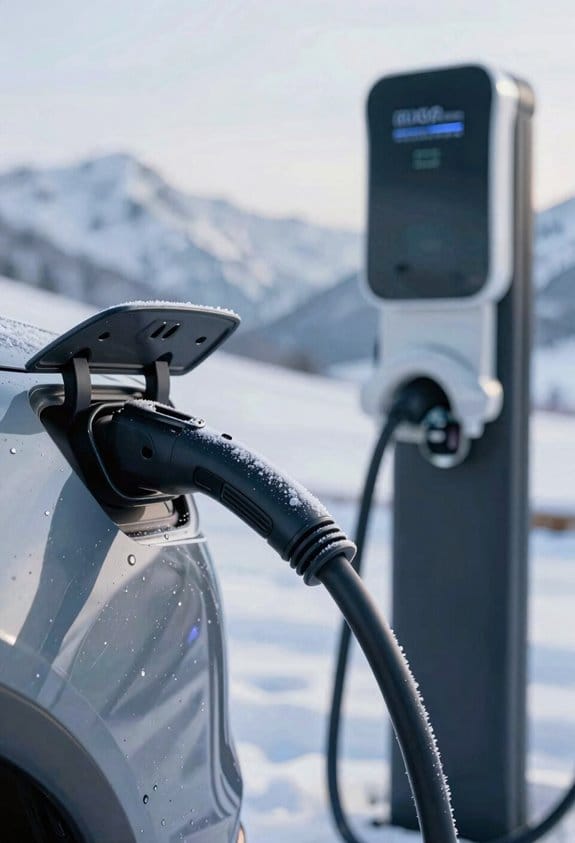
Ever wondered why your outdoor EV charger sometimes feels sluggish on a frosty morning? You’re not alone—temperature and altitude can really mess with performance.
Cold soak
When the air dips below –22 °F, the charger’s internal batteries lose capacity. A few hours of that chill can slow charging speed and even set off thermal protection. Picking a unit rated down to –40 °F keeps things running smoothly.
Altitude derating
Higher up, the air is thinner, so cooling doesn’t work as well. Most chargers handle up to 11,482 ft without a power cut, but beyond that you’ll see limits. Check the maker’s altitude rating before you mount anything.
- Place the charger where it gets shade or good airflow.
- Use a weather‑proof enclosure with the right IP rating.
- Follow local codes for grounding and mounting height.
Fair warning: extreme weather can still bite, even with the right gear. Worth knowing: keep an eye on the charger’s temperature sensors and give it a break if it overheats.
Got a spot that’s both cold and high up? What’s your go‑to setup for keeping the charger happy?
Why Surge, Ground‑Fault, and Leakage Protections Are Essential for Outdoor EV Chargers
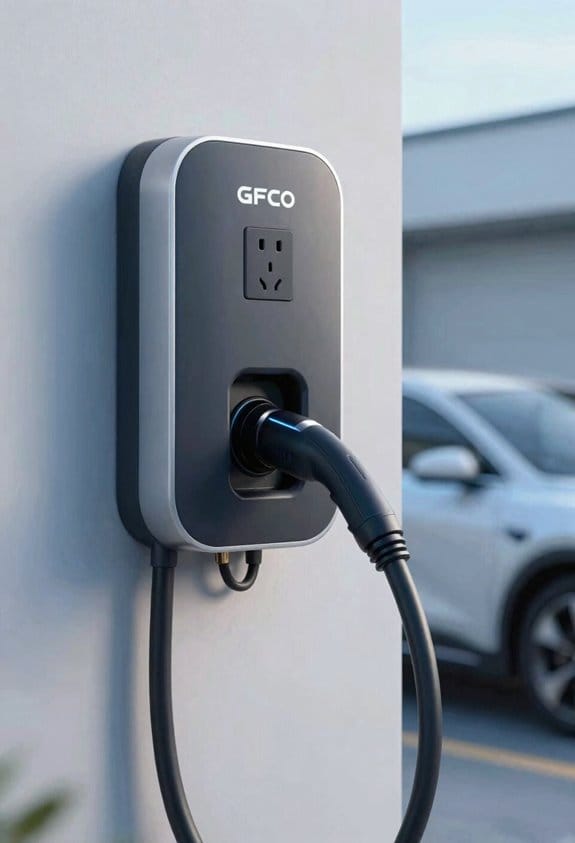
Ever had a rainstorm hit your driveway and wonder if your outdoor EV charger will survive? Those units face lightning, wet soil, and critters, so you’ve got to protect them like you would a garden hose.
Surge protection – It pulls lightning and power spikes away from the charger.
Ground‑fault protection – It spots stray currents that show up when connections get wet or a rodent chews a wire.
Leakage protection – It caps leakage at 20 mA so you don’t get a shock.
Try this: use sealed connectors that block moisture, and pick corrosion‑resistant metals to keep electro‑chemical damage at bay. Install a solid grounding rod during the initial setup, and give the unit a quick visual check every few months for gnawed wires or rust.
Frankly, a good ground connection does more than just keep the charger running—it stops voltage spikes from turning a storm into a fire hazard. When you’re wiring it, make sure the ground rod is driven deep enough and the copper clamp is tight. A loose connection can let a surge sneak through, and that’s the last thing you want on a rainy night.
Worth knowing: regular inspections pay off. Look for signs of water pooling around the box, and trim any nearby vegetation that could trap moisture. If you spot any rust or corrosion, replace the affected parts before they spread.
A quick checklist for you:
- Seal every connector and keep the enclosure tight.
- Choose stainless steel or brass fittings.
- Verify the grounding rod is firmly in place and the wire is properly clamped.
- Schedule a visual inspection at least twice a year.
These habits keep your charger humming safely, even when the weather turns nasty. Ready to give your EV setup the protection it deserves?
Recommended Products

Provides Protection Against:

HEAVY-DUTY WHOLE HOUSE PROTECTION - Protect your electrical panel and connected equipment with a 200kA whole house surge protector designed for 120/240V split-phase electrical systems in residential, commercial, farm, generator, RV, marine, irrigation, solar AC, wind, and EV charging applications.

ETL Listed for Verified Safety – ETL Listed to UL 1449 5th Edition and CSA C22.2 No. 269.1 & 269.2 for trusted safety and surge protection compliance in North American applications.
How Rugged PC‑EXL9330S Housings Protect Outdoor EV Chargers
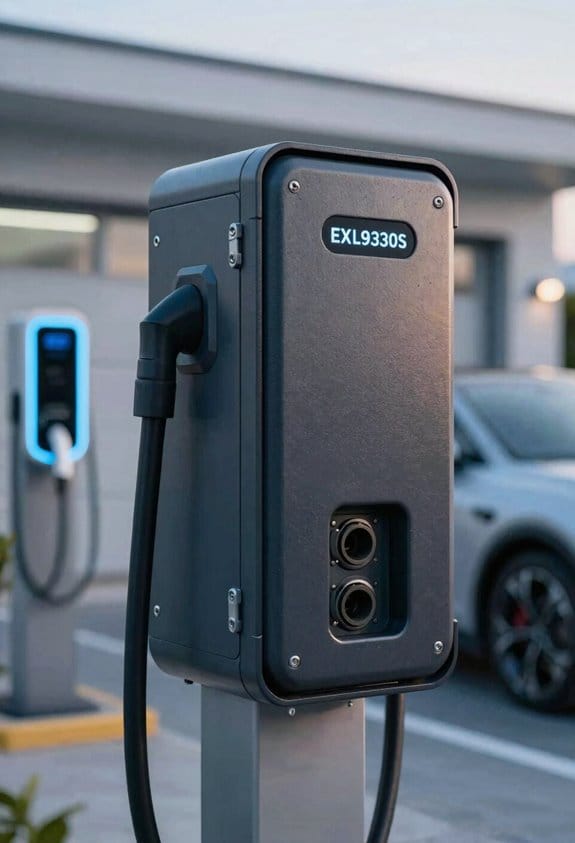
Ever had an EV charger that looks like it survived a hurricane? You probably didn’t, but the right housing can make that happen. The PC‑EXL9330S is built to keep your outdoor charger safe from everyday messes and the occasional mishap.
Weather seal – The IP65 rating blocks dust and water jets, so rain or a dusty driveway won’t mess with the electronics. Temperature range – It works from –40 °F up to 131 °F, handling both scorching summer heat and icy winter nights. Material strength – A polycarbonate frame resists cracking and warping, even if someone leans a bike against it. Mounting flexibility – Its compact size fits wall or pedestal installs, letting you place it wherever you need.
Frankly, these features let you set up chargers in driveways, carports, or parking lots without constantly checking for damage. The housing protects internal electronics, extending service life and cutting down on maintenance calls.
Worth knowing: the impact resistance meets IK10 standards, so stray tools or debris won’t crack the case. UV stabilization keeps the plastic from yellowing or becoming brittle under sun exposure.
If you’re looking for a hassle‑free install, the PC‑EXL9330S gives you peace of mind. You’ll spend less time fixing problems and more time charging up. Ready to make your charger tougher than the weather?
What Cable Length and Mounting Height You Need for Rain‑Exposed Installations
Ever had to plug your EV charger into a spot that’s constantly splashed by rain? It’s a pain when the cord pools water and you worry about safety. The trick is to pick the right cable length and mount the unit high enough so puddles never reach it.
When you’re setting it up, aim for a cable that reaches your car without a lot of slack. Most folks find 18‑25 ft works fine, with 20‑23 ft being the sweet spot for typical cars. Hook the cord onto a sturdy clip or a small bracket so it stays tidy and water can’t sit on it.
Mounting height basics
- Keep the base at least 24 inches off the ground.
- If you live in an area that floods often, bump that up to 36 inches.
- Make sure the connector stays at least 6 inches above the pavement.
These simple steps cut down on water exposure and keep the charger safe. Use solid brackets and double‑check that the wall or post can handle the enclosure’s rating.
Frankly, a little extra effort now saves you headaches later. Worth knowing: a well‑placed charger will stay dry even after a heavy downpour.
Got any other rain‑proofing tips you swear by? Let’s keep the conversation going.
Hard‑Wired vs. Plug‑In: Which Wiring Method Is More Reliable for Outdoor EV Chargers?
Ever wondered why your outdoor EV charger sometimes feels like a loose‑end after a storm? I’ve been there, and the answer usually comes down to how the unit is wired.
Hard‑wired
- Direct conduit to the charger housing
- Sealed junction boxes with IP65 or NEMA 4 rating
- Integrated freeze protection for cold climates
Plug‑in
- Removable cable and plug assembly
- Requires high‑quality weatherproof connectors
- Needs extra sealing to prevent moisture ingress
When you go with a hard‑wired setup, you’re basically giving your charger a solid, permanent link that doesn’t loosen over time. The sealed boxes keep rain and dust out, and the built‑in freeze protection means you won’t be scrambling for a fix when temperatures drop. I’ve seen a few plug‑in kits get moved around a lot, and each time the plug is unplugged, there’s a tiny chance water could sneak in.
Frankly, the biggest upside of hard‑wiring is the peace of mind you get knowing there’s one fewer place for moisture to hide. The connectors are weatherproof, so you don’t have to worry about a sudden leak turning into a costly repair. Plus, the conduit can be run through a wall or underground, which adds an extra layer of protection against the elements.
Plug‑in kits do have their perks—like the ability to pull the charger out for a different spot or to store it away when you’re not using it. But every time you detach the plug, you create a new potential leak path. If you live in a region that sees a lot of rain or snow, that extra risk can add up quickly.
Worth knowing: If you decide on a plug‑in system, make sure you use top‑tier weatherproof connectors and double‑check the sealing on every joint. It’s a bit more work up front, but it can keep the water out if you really need that flexibility.
Choose hard‑wired when you need long‑term durability and minimal maintenance. It’s the kind of setup that just stays put, no matter how harsh the weather gets. Have you tried a hard‑wired install on your own charger yet?
Recommended Products

Grizzl-E Ultimate with 25ft Cable is the 80A 19.2kW, Wi-Fi-connected EV Charger with J1772 or NACS charging connector. Made in Canada with a heavy-duty UL Type 4 Indoor/Outdoor Rated metal enclosure to withstand any indoor or outdoor condition

Introducing the Emporia Pro Level 2 EV Charger

ready-to-wire right out of the box
Key UL, CSA & SAE Certifications for Outdoor EV Chargers
Ever wondered why some outdoor EV chargers seem to fry after a few weeks while others keep humming? The secret lies in the safety marks they carry. Those little logos aren’t just for show; they tell you the charger survived real lab tests and meets local code rules.
UL 2202 – This one guards against fire and electric shock, a must‑have for any U.S. install.
CSA 22.2 No. 280‑16 – Canada’s counterpart; it checks the same safety and environmental standards.
SAE J1772 – Sets the connector shape and communication protocol so your car will actually talk to the charger.
Worth knowing: also keep an eye out for UL 1998 and UL 2231, which cover overall equipment safety. The NEMA or IP rating should match the weather you’ll face—think rain, dust, or snow. And don’t forget to verify that the maker cites the latest NEC and Canadian Electrical Code editions.
Frankly, skipping these checks can leave you with a charger that trips breakers or, worse, starts a fire. You’ll want a unit that’s built to handle the outdoors, not just a garage.
Try this: before you buy, pull up the product sheet and scan for those certification symbols. If they’re missing, ask the seller for proof or move on to another model.
Choosing a charger that ticks all the boxes means fewer headaches and a smoother charging experience for your car, no matter the season. Ready to give your EV the safe, reliable power it deserves?
Recommended Products

Universal Compatibility: The IQ 60 EV Charger features a ruggedized NACS connector and is ideal for Tesla electric vehicles and other NACS-compatible electric vehicles with acceptance rates up to 11.5kW. Plus, you may qualify for federal and local tax credits and rebates for home electric car charging.
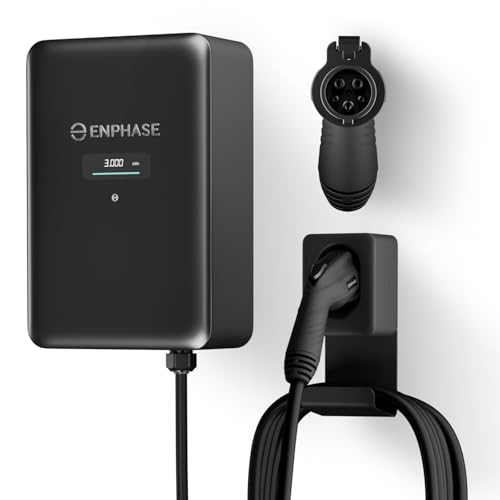
9× FASTER CHARGING: Get faster, smarter EV charging up to 11.5 kW (up to 46 miles/hour). Perfect for overnight charging or quick top-ups.

DUAL-PORT CONVENIENCE – Built with two independent charging ports, the REV+ dual port level 2 EV charger powers two EVs or plug-in hybrids simultaneously, making it ideal for households with more than one electric vehicle.
Why Power Factor and Efficiency Matter for Outdoor EV Chargers in Harsh Climates
Ever tried to charge your EV outside when the weather’s biting or scorching? You’ll notice the charger gets hotter, and sometimes it just won’t keep up. That’s often because of power factor and efficiency—two things that matter a lot in harsh climates.
Power factor
- Keeps the current draw low, so the wiring doesn’t overheat.
- Cuts down harmonic distortion, which can otherwise fry components.
Efficiency
- Limits waste heat, making thermal management easier.
- Saves electricity, especially when temperatures swing wildly.
A high power factor (over 0.99) means the charger isn’t pulling a lot of reactive power. A high efficiency—around 95 %—means there’s less heat to get rid of. When you pick a unit that scores well on both, you won’t need extra cooling fans or big heat sinks. That helps the charger stay within its safe range, from –40 °F to 131 °F, without breaking down. It also protects the enclosure from moisture‑induced corrosion that excess heat can cause.
Worth knowing: Check the spec sheet for power factor and efficiency before you install anything.
Tip: Verify the spec sheet for power factor and efficiency before installation.
Frankly, when you choose a charger with both high power factor and high efficiency, you’re basically giving your EV a reliable home in any weather. Have you ever had a charger fail because it overheated?
How OCPP and OTA Updates Keep Your Outdoor EV Charger Running Year‑Round
Ever had an outdoor EV charger freeze up right when you need it most? It’s frustrating, especially when you’re counting on it through rain, snow, or a scorching summer day. The good news is that the combo of OCPP and OTA updates can keep your charger humming all year long.
Remote diagnostics
OCPP lets you peek at voltage, temperature, and error codes straight from the cloud. You can spot a problem before it forces a shutdown, which saves you time and money.
Firmware resilience
When a new firmware version is ready, OTA pushes it to the charger automatically. Those updates often patch bugs and tighten protection against rain, snow, and dust, so the unit stays safe in harsh weather.
Continuous compliance
Cloud logs give you a paper trail that shows you’re meeting UL, SAE, and NEC standards. That way, you won’t be caught off guard during an inspection.
Simple maintenance
You don’t have to pry open the enclosure for every little fix. Technicians can schedule a visit only when a real issue shows up, cutting down on unnecessary trips.
Frankly, if you’re relying on an outdoor charger, you want it to work without you having to chase down every hiccup. Worth knowing: keep the firmware up to date, and let the cloud do the heavy lifting. Have you checked your charger’s OCPP settings lately?
Frequently Asked Questions
Can Outdoor EV Chargers Be Installed on a Mobile Cart?
Certainly, we can mount sturdy chargers on mobile carts, ensuring seamless cart mobility and mobile docking. Our rugged enclosures, IP‑rated protection, and flexible cable lengths make outdoor deployment simple, safe, and reliable.
How Does Salt Spray Affect Charger Longevity?
We’ve found that salt spray accelerates corrosion testing, leading to oxide formation on contacts and enclosures, which can degrade conductivity and cause premature failure if the charger isn’t properly sealed.
Are There Specific Maintenance Schedules for Outdoor Units?
We recommend seasonal inspections and connector lubrication; check seals, clean debris, and re‑apply lubricant each spring and fall to keep contacts dry, prevent corrosion, and guarantee reliable outdoor performance.
What Is the Recommended Grounding Method for Wet Locations?
We recommend using equipment grounding with an isolated ground conductor, bonded directly to the charger’s chassis and the building’s grounding electrode, ensuring low impedance paths and compliance with wet‑location codes.
Can Solar Panels Directly Power an Outdoor EV Charger?
We can run an outdoor EV charger directly from solar panels, but we’ll need a solar inverter to convert the DC and and battery buffering to smooth out fluctuations and store excess energy for consistent charging.