As an Amazon Associate, we earn from qualifying purchases. Some links on this site are affiliate links at no extra cost to you. Our recommendations are based on thorough research and editorial judgment.

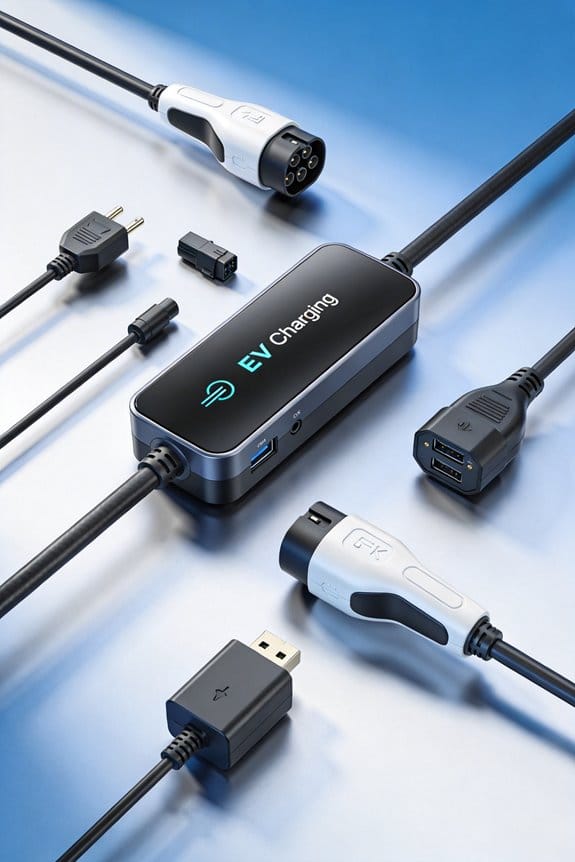
How EV Charging Standards Are Becoming Easier to Follow

We’ve made EV standards easier by bundling the NEVI minimum‑port rule (and keeping EV charger adapters handy for mixed networks), plus a CCS adapter for Tesla when needed, CCS Type 1, GFCI safety, ultra‑fast 400‑500 kW chargers, monitoring, and V2G prep into clear steps. 1) Install at least four ports, mix fast and Level 2, and keep traffic flow. 2) Use CCS Type 1 for all fast ports and a payment system that supports RFID, app, and cards. 3) Add a GFCI at the service panel and test it before use. 4) Choose sites near substations, add chillers, and plan for redundancy. 5) Connect each charger to a cloud dashboard, set alerts, and aim for 97 % uptime. 6) Add bidirectional chargers for V2G and link them to a home energy manager. Follow these steps and you’ll see how the process continues to simplify.
Key Takeaways
- Uniform connector standards like CCS Type 1 simplify hardware selection and reduce inventory complexity.
- NEVI’s minimum‑port rule mandates four ports per station, providing consistent redundancy and easier capacity planning.
- Integrated payment platforms that support multiple methods (RFID, app, credit card) streamline user experience and compliance.
- Standardized safety practices, such as upstream GFCI installation and NEC 2026 compliance, ensure consistent installation procedures.
- Cloud‑based monitoring and predictive‑maintenance dashboards give operators real‑time insights, making compliance tracking and upgrades more straightforward.
What Is the NEVI Minimum‑Port Rule and Why It Matters?
You may be interested

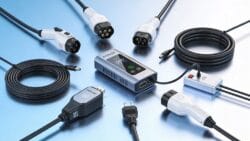
Ever wonder why some new charging stations seem to get all the funding while others get left behind? The secret lies in the NEVI minimum‑port rule, and it’s something you’ll want to get right from the start.
We’ll start by breaking down the NEVI minimum‑port rule so you know why it matters for every new charging site. The rule says each station must have at least four ports, mixing DC fast and AC Level 2 as needed. This minimum ports count drives funding impact because NEVI grants only cover sites that meet the rule. It also creates network redundancy; if one port fails, three others stay online, keeping uptime high. Finally, the rule shapes site layout, forcing planners to space ports for safe access and power distribution.
Key points
- Four ports = eligibility for NEVI money.
- Redundancy = better reliability.
- Layout must allow clear traffic flow.
Follow these steps to stay compliant and secure funding.
Frankly, you’ll want to map out your site before you order any equipment. Start with a sketch of the lot, then place the four ports so they’re not too close together—this keeps traffic moving and makes it easier to hook up the power. If you’re mixing DC fast and AC Level 2, think about where drivers will park while they charge; the fast chargers should be near the entrance for quick turn‑arounds, while the slower Level 2 units can sit a bit farther back.
Worth knowing: when you apply for a NEVI grant, the reviewers will check the site plan for compliance. A clear, well‑spaced layout shows you’ve thought about safety and efficiency, which can tip the scales in your favor. Also, make sure the electrical infrastructure can handle the load of four ports at once—nothing stalls a project faster than a busted transformer.
Here’s the trick: use a modular design that lets you add more ports later without a full rebuild. That way, if funding rules change or demand spikes, you won’t have to start from scratch. Keep a spare breaker panel on hand; it’s a small extra cost that saves a lot of headaches down the road.
If you follow these pointers, you’ll keep your station eligible for NEVI money, boost reliability, and give drivers a smooth experience. Ready to get your charging site up and running?
Why CCS Type 1 Remains the Preferred NEVI Connector?
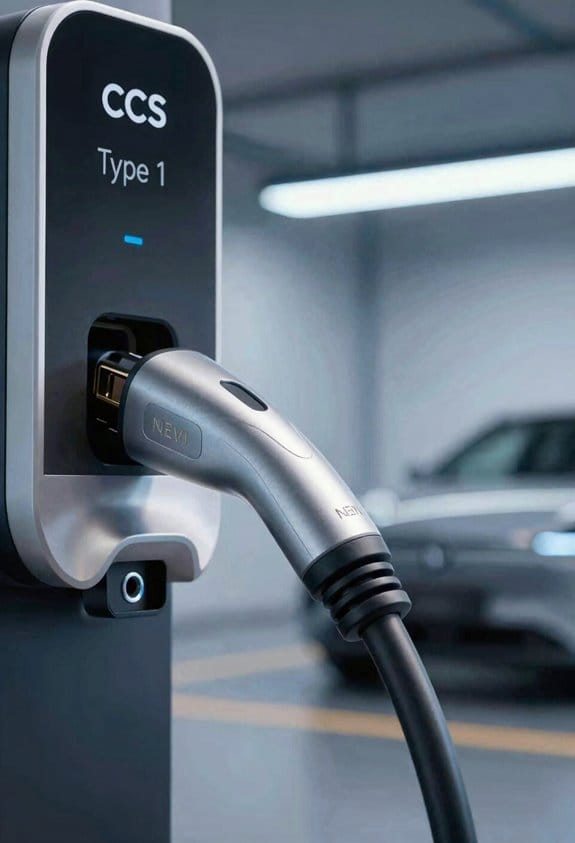
Is your new NEVI‑funded station feeling a bit like a puzzle you can’t quite solve? You’re not alone—picking the right connector can feel like a guess‑work game, but the answer is actually pretty simple.
Recommended Products

NACS TO CCS1 SUPERCHARGER ADAPTER: Charge compatible CCS1 electric vehicles at Tesla NACS Supercharger stations using this high-performance LENZ adapter. Optimized for fast, reliable DC charging on approved non-Tesla EVs.

POWER-The AC can reach 32A. DC can go up to 400A. The maximum AC voltage is 250V and the maximum DC voltage is 1000V

Compatibility: The CCS1 to CCS2 EV charger adapter fits all CCS2 standard EVs, making it a highly compatible adapter that eliminates your worries about charging problems
Why we prefer CCS Type 1
- It’s required by the NEVI standards.
- It supports up to 500 kW charging.
- It works with most vehicle brands today.
- It simplifies maintenance and inventory.
Frankly, the reason CCS Type 1 shows up on every DC fast‑charging port is that it fits almost every EV on U.S. roads right now. You’ll also notice that the NEVI rule says each DCFC port must have a CCS Type 1 plug, so you won’t be breaking any rules. The plug’s design means you won’t have to swap out hardware when newer models hit the market, which saves you time and money.
When you’re setting up a station, think about the day‑to‑day reality of keeping it running. A single type of connector means your staff only needs to learn one system, and you can stock fewer spare parts. That cuts down on both training and inventory costs, which is a big win for any operator.
Worth knowing: using CCS Type 1 also means you’re ready for the future. As automakers roll out newer EVs, they’re sticking with the same standard, so your station stays relevant without a costly upgrade. It’s a practical way to stay ahead without overcomplicating things.
If you ever wonder whether another connector could work better, ask yourself: does it meet the NEVI rule and cover the breadth of current EV models? The answer is usually no, which is why most stations stick with CCS Type 1.
How Qualified Installers Should Implement GFCI for NEVI Chargers?
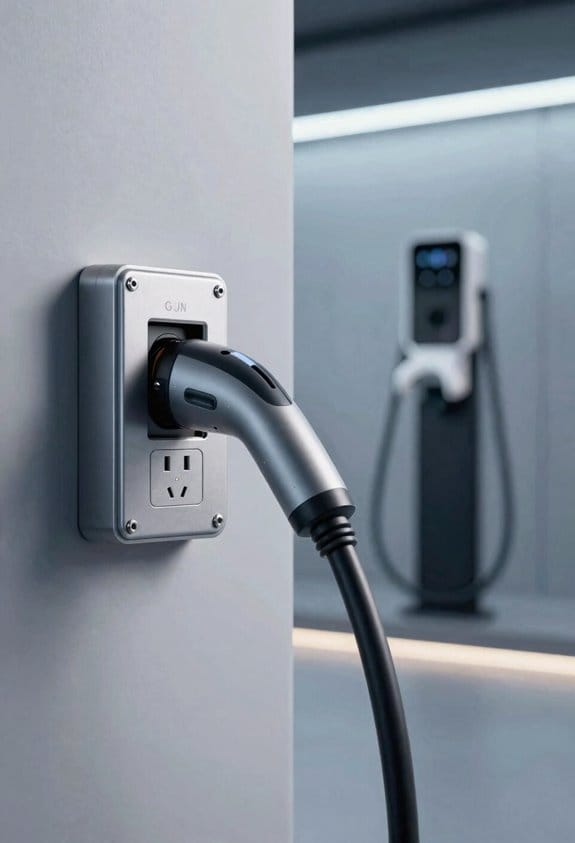
Ever wondered why your NEVI‑funded charger keeps tripping the GFCI? It’s usually a wiring misstep that you can avoid with a few careful checks. Below is a practical guide that lets you keep things safe and compliant without the headache.
Recommended Products

🔌𝐆𝐅𝐂𝐈 𝐎𝐮𝐭𝐥𝐞𝐭 𝐰𝐢𝐭𝐡 𝟐 𝐔𝐒𝐁 𝐏𝐨𝐫𝐭𝐬: Ground Fault Circuit Interrupters with Dual USB Ports (Type-A + Type-C) – Supports USB charging for all devices. The package comes with 10 pack 20 A outlets, perfect for covering multi-room or multi-scene use. Say goodbye to bulky chargers and power your smartphone, tablet, earbuds, and more with ease

Single pole, 20 Amp, type QPF2 GFCI Circuit Breaker

POWERFUL - 2 high-powered charging ports with 3.6A of charging powe
Load calculations
First, figure out the total amperage of all the ports you plan to install. Make sure the circuit you pick can handle that load plus a comfortable safety margin. A quick math check now saves you from overheating later.
GFCI placement
Install the GFCI at the service panel or a dedicated sub‑panel, right upstream of the charger. That way any ground fault gets caught early, before it reaches the charger itself. Positioning it up‑stream also keeps the rest of your system protected.
Manufacturer coordination
Before you finish wiring, get a hold of the charger’s internal protection scheme. Some models have built‑in GFCI‑like features that could clash with an external unit. Ask the manufacturer for a wiring diagram so you can line everything up correctly.
Final check
Once everything’s wired, give the GFCI a test with a fault simulator. Then power up the charger and watch for any nuisance trips. If it stays steady, you’re good to go.
Frankly, the trick is to treat the GFCI like a safety net that you install before the charger, not after. This simple order of operations keeps the whole setup reliable and hassle‑free.
Got any other tips for installing EV chargers? Share your experience!
Deploy NEVI‑Compliant 400‑500 kW Ultra‑Fast Chargers: Practical Tips
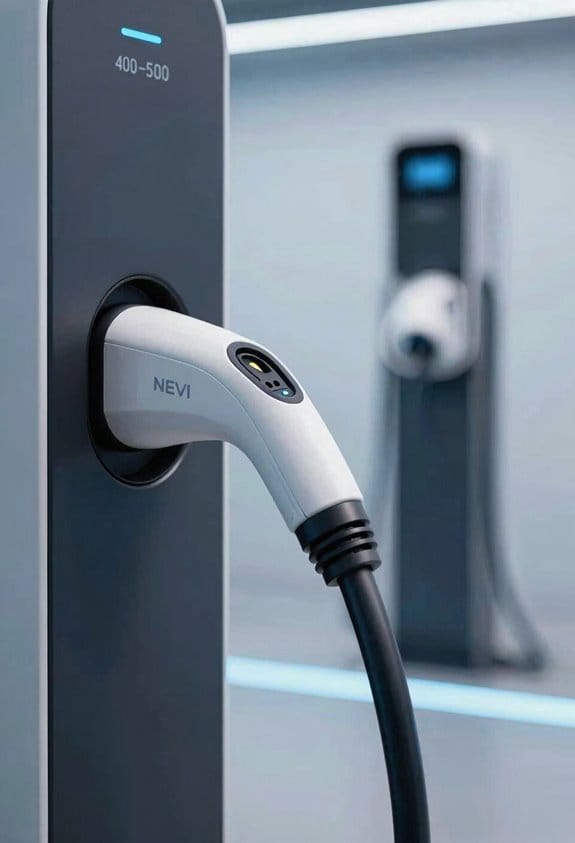
Ever wonder why your ultra‑fast charger project feels like a maze? You’re not alone—getting a 400‑500 kW station up to code can feel overwhelming, but a few practical steps can keep you on track.
Deploy NEVI‑Compliant 400‑500 kW Ultra‑Fast Chargers: Practical Tips
Deploying a 400‑500 kW ultra‑fast charger that meets NEVI rules starts with solid planning. We begin with site selection. Choose locations near existing substations and highways. Verify that the land can support a large foundation and has easy access for trucks.
- Grid upgrades
- Work with the utility to assess capacity.
- Add transformers or feeders if needed.
- Install a dedicated service panel.
- Use liquid‑cooled cables for high power.
- Size chillers for ambient temperature ranges.
- Include redundancy to avoid downtime.
- Choose a platform that supports CCS and NACS.
- Make sure RFID, app, and credit‑card options work.
- Test transaction flow before launch.
Frankly, start with a quick walk‑through of the spot you’re eyeing. Look for a clear path for heavy trucks and a solid slab that can hold a big foundation without sinking. If the ground feels soft, you’ll waste time and money later.
Here’s the trick: Talk to the local utility early on. They’ll tell you if the existing feeder can handle the load or if you need a new transformer. Getting this info now saves you a scramble when the construction crew shows up.
Worth knowing: For cooling, liquid‑cooled cables are a must at this power level. They keep the system safe and efficient, especially when summer temps climb. Make sure your chiller can handle the hottest days you expect, and add a backup unit so a single failure doesn’t shut you down.
If you’re setting up payment, pick a platform that already speaks CCS and NACS. Test RFID cards, mobile apps, and credit cards before you go live. A smooth checkout experience keeps drivers happy and reduces support calls.
Fair warning: Skipping redundancy on the cooling side can bite you hard during a heat wave. A single chiller failure could force you to shut the whole station, costing you revenue and reputation.
Try this: Run a mock transaction with every payment method you plan to offer. Spot any glitches now, and you’ll avoid a frustrating launch day.
How to Use Monitoring Software to Achieve 97 % Uptime on NEVI Chargers?
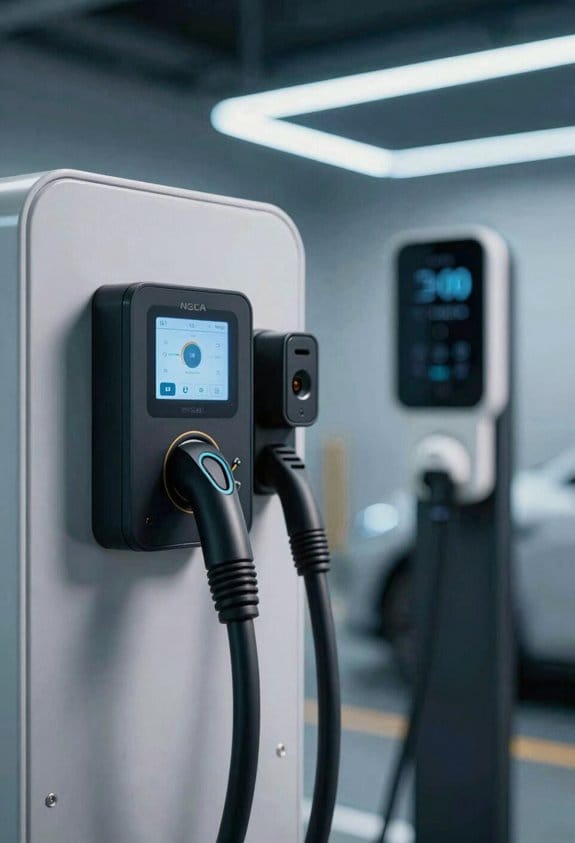
Ever had a charger go dark right when a driver needs it most? That sudden outage can turn a quick pit‑stop into a whole hassle, and it hurts your reputation. The good news is you can catch most problems before they happen, just by setting up a simple monitoring system.
We’ll start by installing a cloud‑based dashboard that logs every charger event in real time. Once the dashboard is live, you’ll see each port’s status at a glance. Then you set up alerts for temperature spikes, power drops, and communication loss—so you get a heads‑up before a charger goes offline.
- Connect each charger to the platform via Ethernet or cellular.
- Activate predictive maintenance rules that flag components approaching failure.
- Use usage analytics to track session length, energy delivered, and idle time.
- Review alerts daily.
- Schedule service when a pattern emerges.
- Compare analytics across stations to spot outliers.
Frankly, the key is to treat the data like a daily health check. Look at the numbers each morning, and you’ll spot trends before they become emergencies. If you notice a port heating up more than usual, a quick inspection can prevent a costly shutdown.
Here’s the trick: keep the alert thresholds tight but realistic. Too many false alarms and you’ll start ignoring them; too few and you’ll miss the early signs. Fine‑tune the settings after a week of real data, and you’ll find a sweet spot that works for your fleet.
Worth knowing: the usage analytics also help you plan upgrades. Stations that consistently run at high capacity may need extra power or a newer model, while under‑used ports could be repurposed.
How to Future‑Proof NEVI Stations With V2G and Smart‑Home Integration?
Ever wonder why some EV chargers feel like they’ll be obsolete in a few years?
If you’re planning a NEVI station that stays useful as tech shifts, think about adding V2G and smart‑home links right now.
Recommended Products
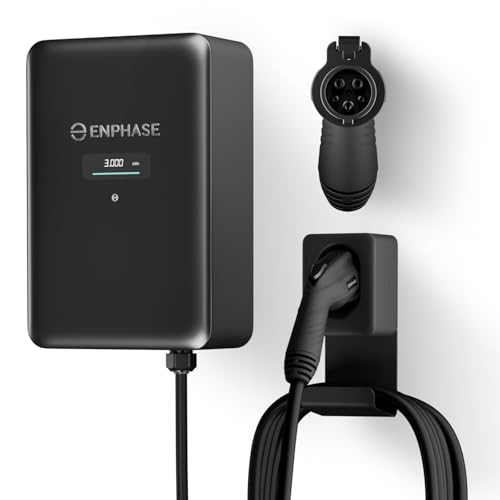
9× FASTER CHARGING: Get faster, smarter EV charging up to 11.5 kW (up to 46 miles/hour). Perfect for overnight charging or quick top-ups.

AI-POWERED SMART CHARGING & APP CONTROL – This ev charger level 2 uses Autel’s AI-integrated smart app to schedule charging around time-of-use utility rates, helping lower your monthly bill while boosting station utilization. Start or stop sessions remotely, adjust current from low to high amps, view real-time energy data, and get alerts if anything looks off.

INSTALL WITH CONFIDENCE: The Enphase HCS-50 EV Charger, formerly known as ClipperCreek, delivers award-winning durability and reliability. Installation is quick and straightforward—connect it to a dedicated 50 Amp circuit by any licensed electrician.
Install bidirectional chargers
Pick a charger that can both draw power from the grid and push it back when needed. That way your station can act like a small battery for the neighborhood or a home during peak hours.
Connect to a home energy manager
Hook the charger up to a home energy manager so it can sync with thermostats, solar panels, or other smart devices. The charger will then react to real‑time signals, turning on when solar output is high and off when demand spikes.
Follow NEC 2026 rules
Hire a certified electrician who knows the latest NEC 2026 requirements. Proper wiring, grounding, and labeling will keep the station safe and up to code.
Enable remote firmware updates
Make sure the charger can receive over‑the‑air updates. That keeps the software fresh without you having to climb a ladder.
- V2G lets the car give power back to the grid or home during peak demand.
- Smart‑home syncing lets the charger respond to thermostat or solar output signals.
- Network‑connected ports help you hit the 97 % uptime requirement.
Frankly, the best way to future‑proof your station is to treat it like a piece of the home’s energy puzzle, not just a parking‑lot add‑on. Worth knowing: you’ll need a reliable internet connection for remote updates and to keep the network‑connected ports humming.
Try this: start with a small pilot station, test the V2G flow, and watch how it balances the load. If the results look good, roll the same setup out across your network.
Will you give your NEVI stations the upgrade they deserve?
Frequently Asked Questions
Can I Mix NACS and CCS Connectors on the Same NEVI Station?
We can mix NACS and CCS connectors on a NEVI station, but we must guarantee connector compatibility and adapter safety; using certified adapters and proper wiring keeps the system reliable and compliant.
Do I Need a Separate Permit for Hard‑Wired Versus Plug‑In Chargers?
We’ll tell you straight: a hard‑wired charger needs an electrical permit and installer certification, while a plug‑in usually doesn’t—though local rules may still demand a permit for safety compliance.
Will a 5 mA GFCI Trip During Normal High‑Power Charging?
We’ll likely see a 5 mA GFCI trip during high‑power charging if fault‑nuisance or ground‑detection thresholds aren’t calibrated correctly, so ensuring proper settings and quality wiring is essential.
How Often Must I Calibrate the Station’s Uptime Monitoring System?
We recommend performing routine checks monthly to make certain data integrity, so the uptime monitoring system stays accurate and compliant with the 97 % reliability mandate. This schedule balances precision with operational practicality.
Are There Rebates for Adding V2G Capability to Existing NEVI Chargers?
We see utility incentives lighting up like sunrise, and firmware upgrades smoothing the path—yes, rebates exist for adding V2G to NEVI chargers, covering part of the hardware and software costs.